
Are you paying for the most efficient way to machine your aluminium component, or are you paying for how your supplier is equipped to machine it?
The machining of a bespoke aluminium profile can sometimes become a major cost driver, influenced by more than the supplier’s hourly rate. Available equipment, setup time, handling, profile tolerances, and production quantities all affect the final cost. A manufacturer that is extremely competitive for one particular aluminium component may be surprisingly expensive for another. One factory can excel at simple, high-volume production, while another is better equipped for smaller volumes of more complex aluminium profiles.
What factors, then, can influence the machining cost of your aluminium profile, and why?
The same aluminium profile, different machining methods
Reducing the number of setups can significantly reduce machining costs because generally, it reduces time. However, fewer setups do not always mean a cheaper process.
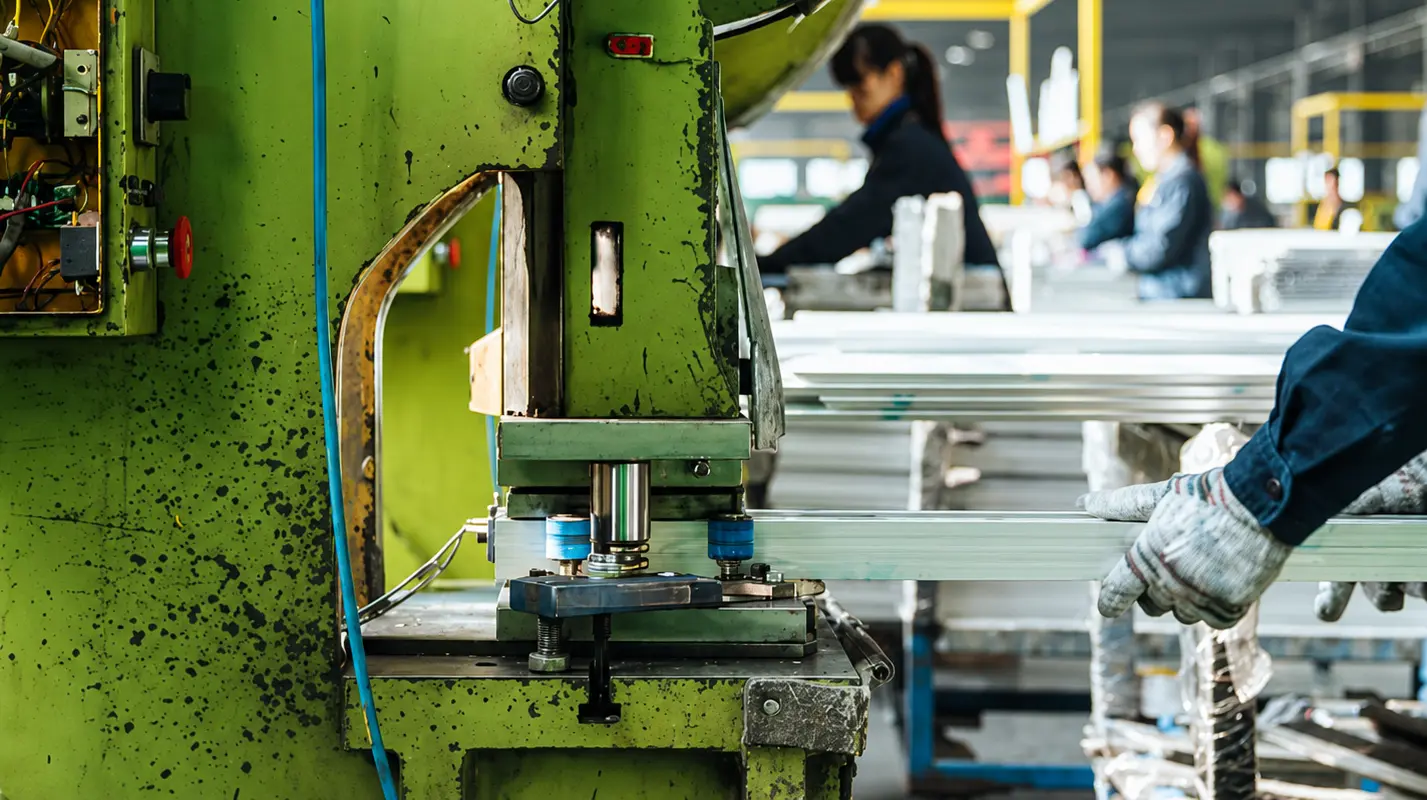
Consider a bespoke aluminium profile for a door-entry keypad housing, with repetitive button apertures and fixing holes, as well as two additional holes on the side. One manufacturer may have automated CNC equipment capable of machining the entire component in one setup. Another might punch the repetitive apertures and fixing holes in one clamped setup, then reposition the profile to punch the holes on the side. The punch press method, in this case, despite requiring more than one profile position, could achieve a significantly shorter cycle time, greater precision—with a consistent breakthrough—and a cleaner finish without the need for deburring, resulting in a lower machining cost.
But there is another factor to consider: tooling.
In this example, the door-entry keypad profile is bespoke, which means a dedicated punching tool needs to be designed and fabricated. This adds another layer to the cost calculation. If the tooling needs to be outsourced, CNC machining might make more sense. If the manufacturer can produce the custom tool in-house, however, using a punch press may be more economical, but it will depend on production quantity.
Production quantity can change the cost of machining your aluminium component
Different machining facilities are optimised for different combinations of production volume, profile complexity, and secondary operations. For smaller quantities of aluminium profiles requiring substantial machining, CNC-focused facilities can be highly competitive, because they can more efficiently accommodate complex operations. On the other hand, a manufacturer equipped to combine custom-made machining tools and other machining operations may be more competitive for high-volume components where extensive CNC machining is unnecessary.
Using the keypad example again, at ALUCAD, we fabricate custom-made punching tools in-house whenever suitable. This introduces an initial tooling cost—though much lower than if it were outsourced—so the expected production quantity needs to justify the investment, and it very often does. The initial tooling cost can quickly be amortised across the production run without requiring tens of thousands of profiles. By utilising a dedicated punching tool, we were able to reduce one customer’s machining time (and subsequently cost, too) by more than 50% compared with their previous CNC heavy process..
Not only that, custom-made punch press tools can improve repeatability and reduce the risk of non-conformities, too, which is another important factor influencing the cost of machining your aluminium product.
Speed plays more than one role in the cost of aluminium profile machining
Consider a profile requiring operations on several faces. The cutting itself may be relatively straightforward, but if the component needs to be unclamped, repositioned, realigned, and clamped again several times, a lot of production time is spent handling rather than machining. This adds cost, and it can also introduce additional variation. Every reposition creates a risk for positioning variation and, if this becomes excessive, can significantly increase rejection rates and scrap, which further increases the overall cost.
But a faster machining process with fewer reclamps does not automatically mean a more efficient method. The faster option will not be more economical if it produces significantly more non-conforming components. Each rejected part can represent wasted extrusion, machine capacity, labour, tooling, and potentially surface treatment.
Generally speaking, however, reducing unnecessary handling and repositioning can shorten cycle times while also reducing opportunities for positioning variation.
In the end, however, it is all about how efficiently your manufacturer can repeatedly machine conforming finished components.
Finding the right manufacturer for your bespoke aluminium profile
When a bespoke aluminium extrusion requires substantial secondary operations, it is worth looking beyond the extrusion price and examining how the component will be machined.
How many setups are required? How much handling is involved? Is the process appropriate for the expected quantities? Could repetitive operations be performed differently? Can several machining methods be combined?
These differences can help explain why two seemingly comparable manufacturers can quote very different prices for exactly the same drawing.
The important question isn't simply whether a manufacturer can machine your aluminium profile. It's whether their manufacturing capabilities are the right fit for your particular component.
If you're looking for a manufacturer of custom aluminium components, particularly if your profile requires extensive machining send us your drawings and specifications and we'll send back a quote.
Follow us on LinkedIn to stay updated with our aluminium profile manufacturing insights.