
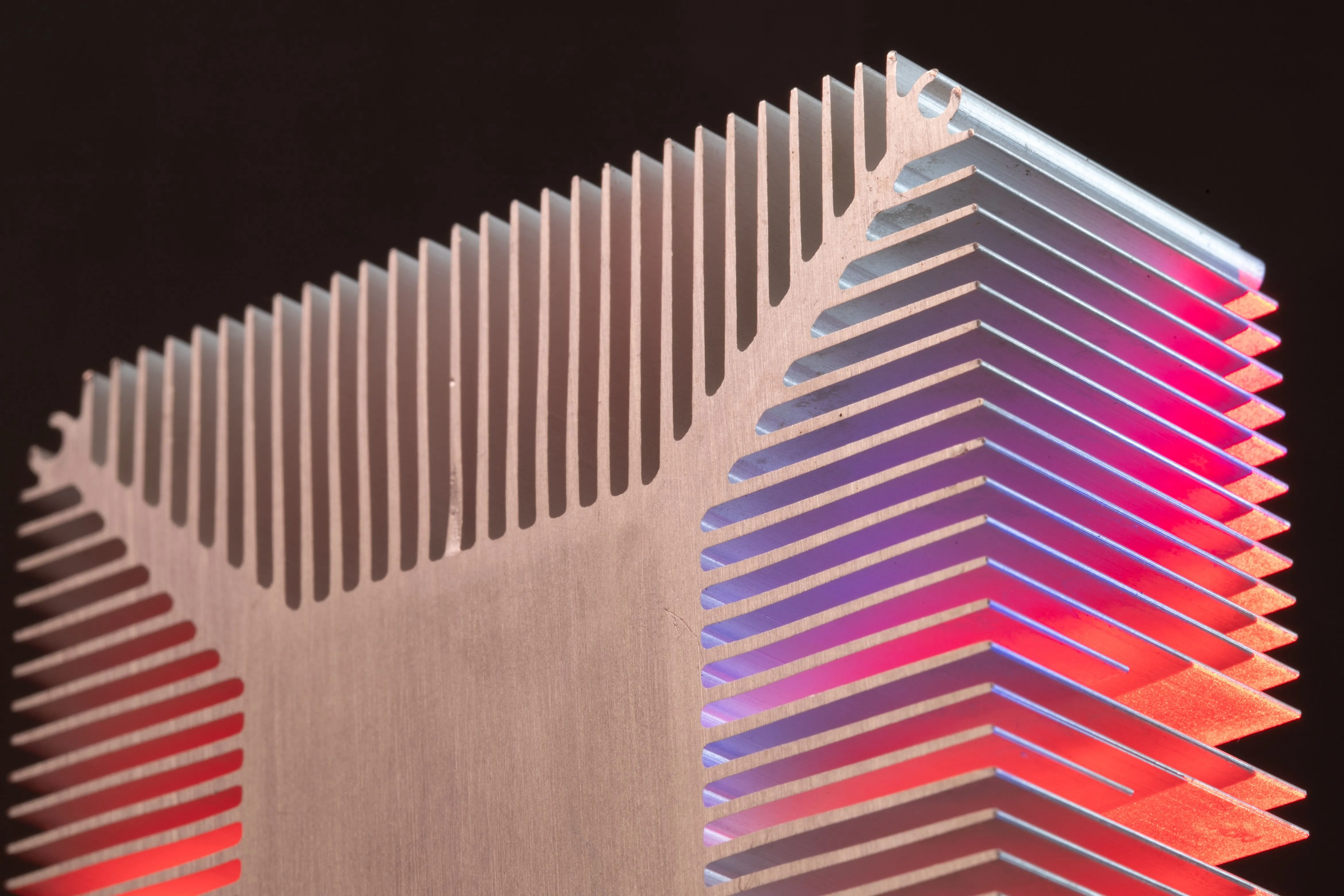
As electronics become smaller and more powerful, the space available for thermal management tends to decrease while the amount of heat that needs to be dissipated increases.
This makes designing an extruded aluminium heat sink more of a challenge, because you want enough surface area to achieve the required cooling performance, but you also want it to be possible to manufacture the aluminium profile reliably.
There's a balance to strike between improving the performance of your heat sink and avoiding aluminium extrusion pitfalls.
Fin design for an extruded aluminium heat sink
The fins on a heat sink increase the surface area available to transfer heat into the surrounding air. So, when space is limited, it seems logical to make the fins thinner, taller and more closely spaced, but actually, there are limits both in terms of thermal performance and extrusion.
Firstly, the smaller the gaps between fins, the more difficult it becomes for air to move between them. While taller fins provide more surface area, it doesn't mean the heat will efficiently travel from the base to the end of each fin.
Then, from an extrusion perspective, thin, tall, and closely spaced fins make an aluminium profile more challenging to manufacture. During the extrusion process, heated aluminium is pushed through a die containing the shape of the profile, and the aluminium needs to flow through every part of that die correctly. As fins become thinner and deeper, controlling this flow and maintaining the required geometry becomes more difficult. Things like cantilever length, push zones, alloy, and in general how extrusion works has to be considered alongside the cooling performance you need.
Understanding the limits of aluminium extrusion
There is no single minimum fin thickness, maximum fin height, or minimum gap that applies to every aluminium heat sink extrusion. What can be manufactured depends on the complete profile, including size, alloy, fin geometry, base thickness, tolerances, the extrusion press used... One particularly important consideration, however, is the relationship between fin height and fin thickness.
As a fin becomes taller relative to its thickness, it becomes progressively more challenging to extrude and keep within tolerance, and heat sinks meant for compact spaces can often push these limits, because designers naturally want to fit as much cooling surface as possible into the available space. But an aluminium profile that is theoretically possible to extrude isn't necessarily the most economical one to manufacture repeatedly. Sometimes, just a slight increase in fin thickness or gap is enough to make production considerably more reliable and cheaper.
The base of your aluminium heat sink profile
It isn't just the fins that need to be considered carefully. The base is important, too.
The base is the section of the heat sink that sits between the electronic component and the fins. It is the part of the heat sink that allows heat to spread into the rest of the profile. And its thickness can have an important effect on the extrusion process.
A very thick base combined with very thin fins creates large differences in material thickness within the same cross-section, which can make it more difficult to control how the aluminium flows through the die. Symmetry and flow balance is one of the important extrusion factors to consider when designing aluminium profiles.
Additionally, the contact surface may require more than what extrusion can provide alone. If specific flatness, surface-finish, or dimensional tolerances are required where the heat sink contacts the electronic component, the surface can be machined after extrusion. Mounting holes, threads, slots, and other features can also be added during secondary machining. And machining and extrusion can each affect the other, so both should be kept in mind during the design stage.
The heat sink should therefore be designed as a finished, machined aluminium component rather than only ensuring extrusion is possible.
Designing compact aluminium heat sinks that are possible to manufacture
The aluminium heat sink profile must balance its thermal requirements with the realities of extrusion.
Thin and tall fins can provide additional surface area but become increasingly challenging to manufacture. A thicker base may be required for thermal reasons but that creates difficulties with material flow.
It can be useful to involve your aluminium extrusion supplier before the heat sink design is completely finalised, have them take a look and see whether it is designed for manufacture whilst maintaining the thermal management performance you require.
Get in touch with us if you're looking for a supplier of aluminium profiles, manufactured to your specifications.
Follow us on LinkedIn to stay updated with our aluminium profile manufacturing insights.