
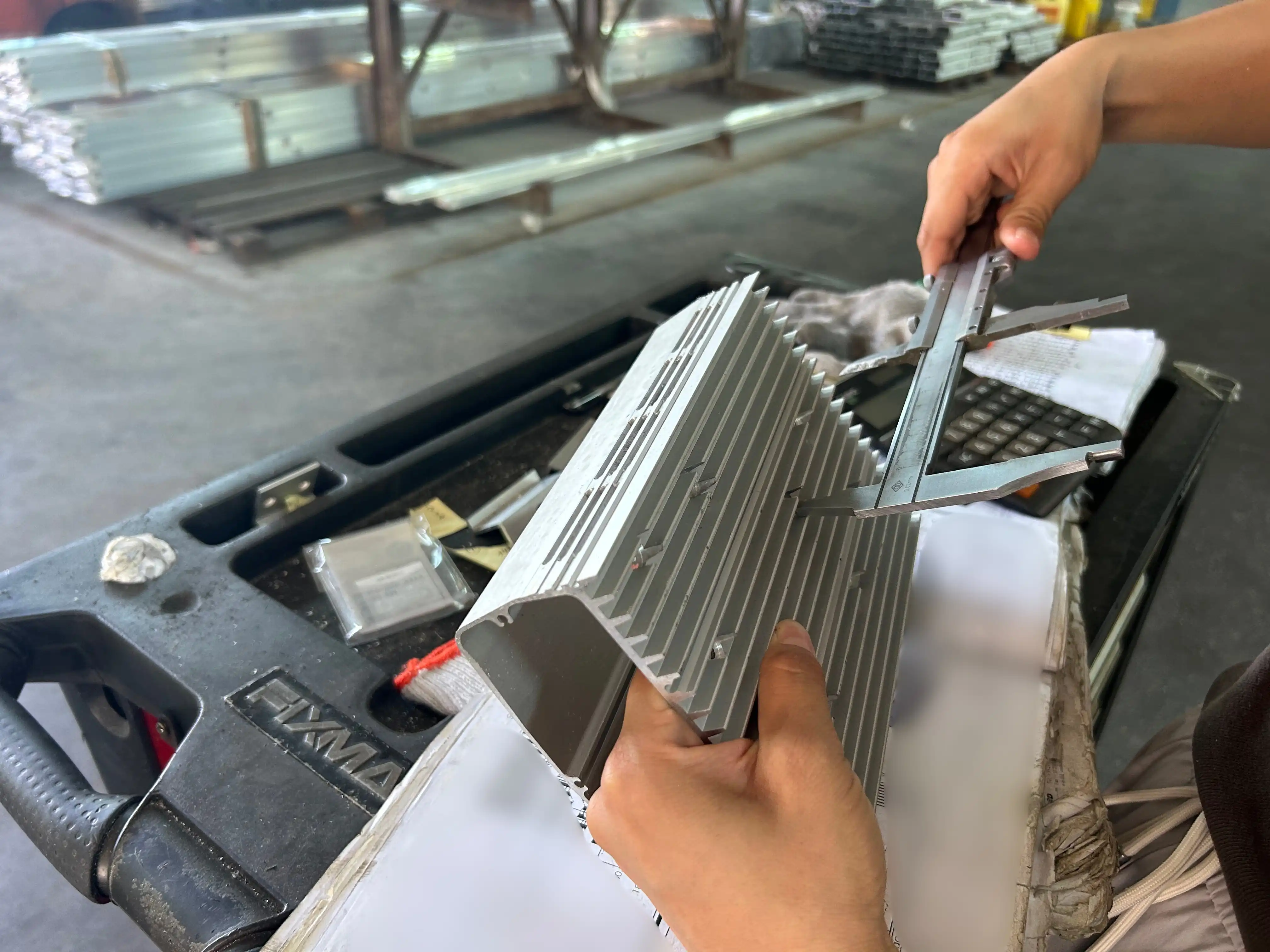
Often, the specified machining tolerances for custom aluminium extrusions are made very tight without improving performance whatsoever, and only increasing manufacturing costs.
In this article, we’ll explain why tight tolerances will bump up costs and whether tight tolerances are genuinely necessary or if you should consider a re-design, and when, sometimes, tight tolerances can be achieved without the high costs.
(At ALUCAD, we work to the ISO 2768 aluminium profile machining tolerances. So, when we say tight, we mean anything considerably tighter than said standard.)
Why do tighter tolerances cost more?
Firstly, the reason tighter tolerances increase cost is because they require more time to machine, thereby increasing costs.
As tolerances become tighter, machining becomes slower to ensure greater control. Fixtures need to hold the part more accurately, cutting tools need replacing more frequently, dimensions need checking during machining, and quality inspections become a lot more rigorous. And, naturally, rejection rates increase because there is less room for normal manufacturing variation. Parts that would have been perfectly acceptable under a more practical tolerance may now fall outside specification and have to be reworked or scrapped. That added machining time, wasted material, and inspection effort all contribute to a higher cost per finished component, or at times, lead to complete rejection of the project.
So, longer machining setup and times, additional inspections, and more scrap, all contribute to a higher manufacturing cost.
When are tight machining tolerances for aluminium extrusions necessary?
The most common reason for needing tight machining tolerances is when parts must fit together very, very precisely. But this doesn't mean every feature should be machined to extremely high accuracy. It should only be for the features genuinely influencing the function of the final product.
Other common applications requiring tight tolerances are bearing housings, where incorrect dimensions can lead to damage during installation or excessive movement in service. Then there is also for critical alignment features, sealing surfaces (for example, where leaks cannot be tolerated), and moving mechanisms, particularly high-speed mechanisms, because loose tolerances and excessive clearance can cause vibration or instability, which again, cannot be tolerated.
It's also important to note that in some designs, you need the tight tolerances for the final assembly but that's only because tight tolerances were applied across multiple parts even though the complete, final product would function perfectly fine with more generous tolerances.
Often, we see custom aluminium extrusion designs that do not need any of the above yet still have very tight tolerances, which doesn't improve the product in any way and only increases production costs. When that is the case, we'll suggest changes.
Could your aluminium profile design allow for more manufacturing variation?
You receive the quote back for the machining of your bespoke aluminium extrusion (with its tight machining tolerances), and it has a lot more zeros than you expected. You'll probably check if your design can be made less sensative to variation (or the manufacturer suggested it be made less strict).
Sometimes, minute design changes can help widen machining tolerances without affecting how the finished assembly performs.
For example, it might be possible to:
• increase clearances between mating components,
• use slots instead of fixed holes,
• increase hole diameters where exact positioning isn't critical,
• separate critical and non-critical dimensions,
• or introduce datum faces to better control the assembly.
These are often small changes on a drawing, but they can have a significant impact on manufacturing cost.
Of course, there are applications where extremely tight tolerances are justified, like mentioned earlier, but for many bespoke aluminium profiles, a smarter design can achieve exactly the same functional result while allowing more practical machining tolerances, which means more reasonable costs for you.
Some machining processes can offer much greater precision
At ALUCAD, unless otherwise specified, we manufacture machined aluminium profile components in accordance with ISO 2768. You can find more on this standard and its tolerances, as well as more on aluminium profile machining, in our Designing with Aluminium Guide.
But, if we can machine the tight tolerance features of your bespoke aluminium profile with a punching tool, well, generally, the story changes.
When we can fabricate a custom punch tool designed specifically for your aluminium profile, the result usually is exceptional repeatability over thousands of parts. Because every component is created using the same hardened tooling, tighter tolerances can often be achieved more consistently than would be economical with CNC machining alone.
You get greater consistency, reduced machining time, lower scrap rates, and overall, seriously reduce the cost per part during larger production runs. Since we fabricate the custom punching tools ourselves here at ALUCAD, if it can be punched, it will almost always be the most cost-effective solution.
But, you can’t always punch a profile, and there will always be variations where it may be possible to punch but the tolerances still remain unreasonable.
Generally, avoid specifying tight tolerances everywhere and apply them only when the precision genuinely really matters.
Follow us on LinkedIn to stay updated with our aluminium profile manufacturing insights.