
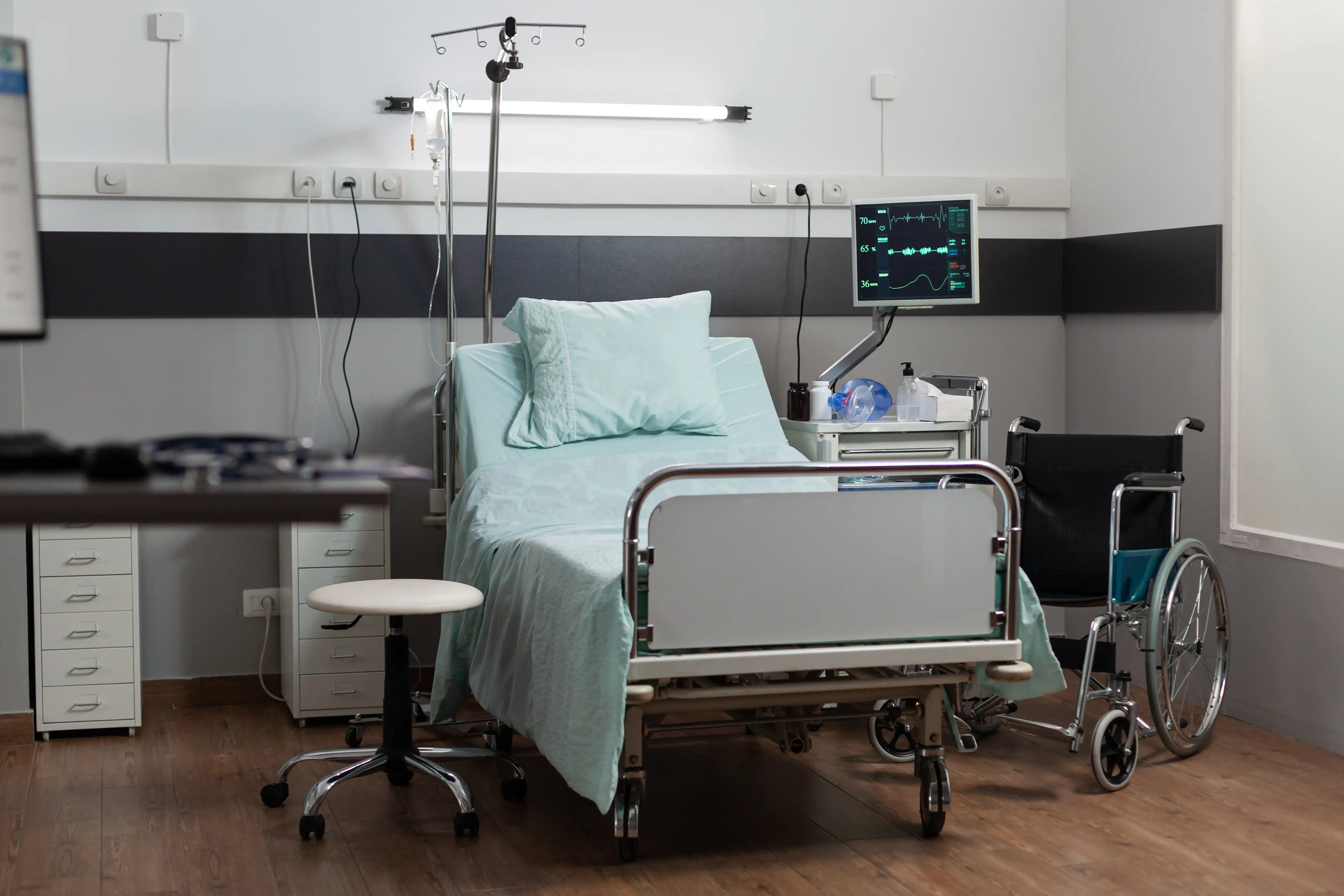
Walk into a hospital and you’ll see aluminium everywhere, but it's not because it looks nice (though it is a bonus). It's there because engineers needed it to solve very specific problems.
Aluminium's strength/weight ratio advantage
Let’s start with the main advantage of using aluminium in medical components. Weight.
Medical systems move. Hospital beds move. Diagnostic carts move. Robotic arms definitely move. Every extra kilogram increases inertia, and more inertia means:
• Larger actuators
• Higher motor loads
• Slower response
• More kinetic energy in a failure scenario
Aluminium's strength-to-weight ratio allows you to maintain stiffness without carrying unnecessary mass. In medical robotics, this directly improves control responsiveness. In mobile imaging platforms, it improves manoeuvrability. In rehabilitation devices, it reduces strain on drive systems.
Using aluminium for your medical component gives you more design freedom
Aluminium extrusion comes in very handy because you're not just getting a structural beam, you get geometry control.
You can build cable channels directly into the cross-section. T-slots can eliminate secondary brackets. Sensor mounts can be integrated. Fastening interfaces can be designed into the structure itself. Instead of welding five parts together and fighting tolerance stack-up, you can engineer the load path directly into the extrusion.
This isn’t possible with stainless steel tube or sheet metal. You can’t build internal geometry into a welded box section. Features have to be added afterwards—brackets welded on, pockets machined in, separate parts bolted together—which increases weight, introduces heat distortion, and compounds tolerance stack-up.
Corrosion resistance and surface engineering benefits in clinical environments
Aluminium does not replace stainless steel in surgical contact surfaces. Steel still dominates in high-sterility zones. But, for structural frames, enclosures, rails, and internal supports, it's a different story.
Hard-anodised aluminium offers:
• Improved corrosion resistance
• Wear resistance
• Chemical stability against disinfectants
• A stable, non-flaking oxide layer
For engineers designing medical components with aluminium, early consideration of surface treatment is essential. Chemical exposure, cleaning cycles, and mechanical wear all need to be evaluated early.
Precision, tolerance control, and aluminium profile machining
Medical equipment does not tolerate misalignment. In sliding systems, robotic joints, and actuator rails, small deviations accumulate quickly.
This is where aluminium profile machining comes in.
Once an extrusion die is validated, the cross-section is reproduced consistently across long production runs. Straightness is predictable. Geometry is controlled. Then you machine what matters.
Machining aluminium extrusions allows:
• Bearing seats to be precision-finished
• Mounting planes to be aligned
• Critical interfaces to meet tight tolerances
You preserve structural efficiency while achieving dimensional accuracy.
The combination of extrusion and machining is extremely powerful in regulated medical manufacturing.
Manufacturing efficiency and lifecycle performance
Now let’s talk about production reality.
When you move from generic box sections to bespoke aluminium profiles, your component changes. You get fewer welded assemblies, reduce distortion risk, less tolerance stack-up, a simplified assembly, and improved repeatability. Meanwhile, integrated features reduce inspection complexity and lower part counts improve traceability.
From a lifecycle standpoint, eliminating welded brackets and excessive fasteners also reduces fatigue concentration points and corrosion interfaces.
So, in other words, you get better performance over time.
Choosing bespoke aluminium profiles for your medical component
So, to recap, most often, engineers design medical components with aluminium to solve the weight problem, the inefficient assembly problem, or the lack of stiffness-to-weight problem. And bespoke aluminium profiles solve all three while also allowing surface treatment, aluminium profile machining, and geometric integration to work together as one system.
As medical devices become more modular, mobile, and robotics-driven, structural efficiency becomes more important.
If you’re developing a new platform and still building complex welded assemblies from standard sections, it’s worth considering if custom aluminium extrusion could reduce weight, part count, and assembly time.
If you’re designing medical robotics, hospital equipment, or clinical devices, aluminium is the most efficient path to better performance, faster manufacturing, and smarter engineering. Contact us to find out how we can manufacture your bespoke aluminium profile so you can bring your medical innovation to life.
Follow us on LinkedIn to stay updated with our aluminium profile manufacturing insights.