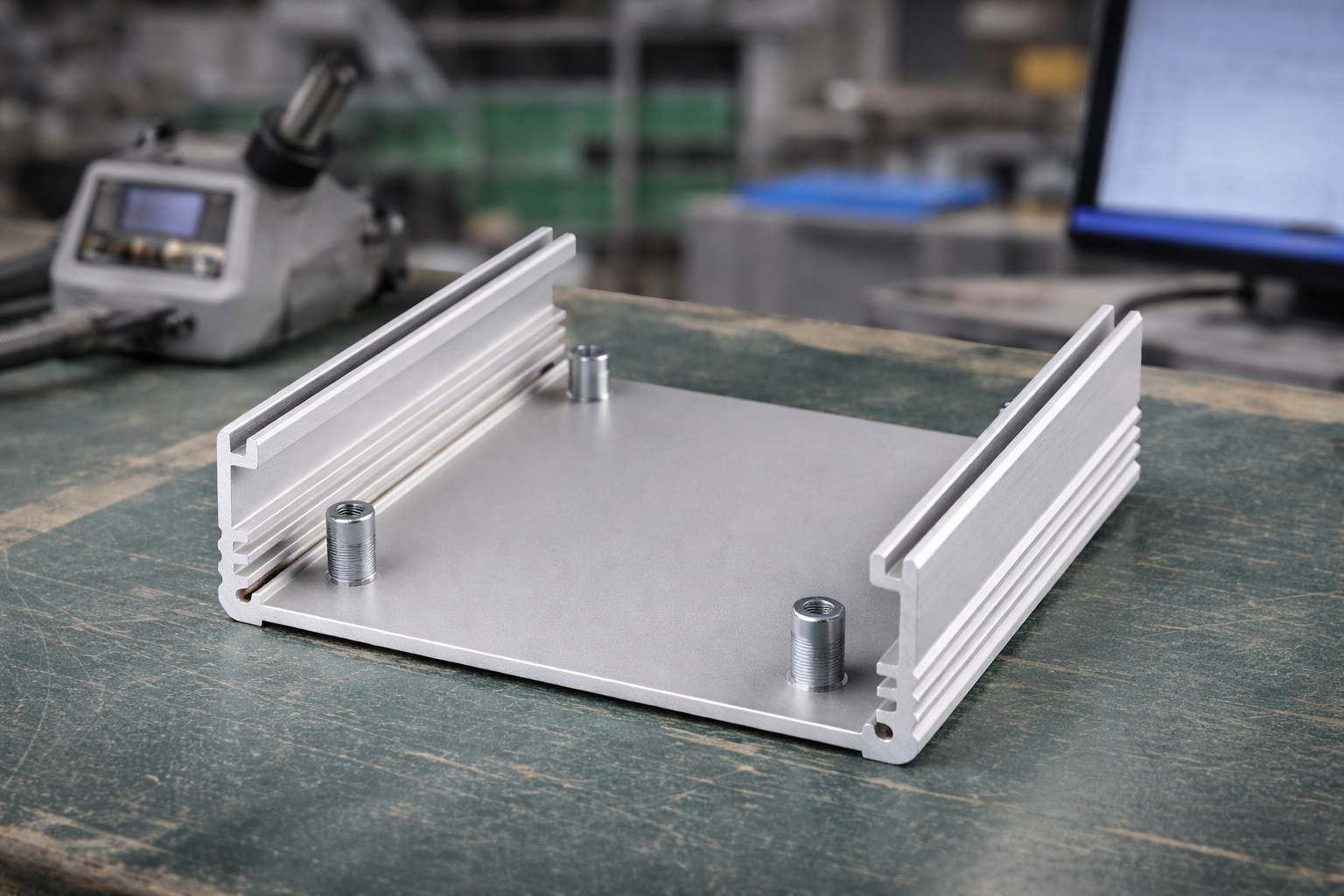
When we think about electronics, we don't usually picture the metal surrounding them. Yet, in high-power and industrial electronics, that metal is one of the most critical components in the entire system.
And more often than not, it is made of aluminium. Not as a thin sheet or a decorative casing, but as a large, custom-designed aluminium profile, engineered to fit tightly around the electronics themselves.
Why aluminium is used in electronic enclosures and components
The reason is simple: heat, current, vibration, and interference.
As systems scale up with higher currents, longer duty cycles, and harsher environments, the structure holding the electronics becomes part of the electrical design. The aluminium is not just housing, but a core functional component.
Aluminium as an integrated heat sink
In industrial power supplies, inverters, LED drivers, battery systems, and medical equipment, heat is constant and unavoidable. Fans can help, but they introduce noise, maintenance, and failure risks.
The most reliable approach is to design the enclosure itself to remove heat.
Large aluminium extrusions with integrated fins, thick walls, and controlled airflow paths act as permanent heat sinks. Instead of adding a cooling system, the aluminium profile is the cooling system, working silently for the entire lifetime of the product.
Thermal and EMC performance must be designed together
An oversight we often see in aluminium housings for electronics is treating thermal management and electromagnetic behaviour as separate problems.
Designs are typically optimised first for heat dissipation, with aluminium used purely as a heat sink. Electrical conductivity and grounding are addressed later using straps, added shields, or conductive coatings. By that stage, the profile geometry is fixed and electrical paths are forced rather than engineered.
The result is usually a compromise. Thermal paths may be effective, but grounding continuity is inconsistent. Or electrical reference points are solid, while thermal transfer is disrupted by interfaces, or surface treatments, or assembly gaps.
Aluminium can handle both roles at once, but only if this dual function is considered early. That means defining continuous metal paths for heat and current, controlling contact interfaces, and selecting surface treatments that preserve both thermal transfer and electrical continuity. When this is done at the extrusion stage, the enclosure naturally acts as both a stable heat path and a controlled electrical reference, without added complexity.
Why standard aluminium profiles rarely work for electronics
Electronics rarely fit neatly into generic shapes. Power components need precise mounting points. Capacitors need spacing for safety and lifespan. Busbars require controlled distances to prevent arcing. Cables need strain relief. Sensors need shielding. Generic profiles force compromises.
A bespoke aluminium profile allows all of this to be designed into a single structure. Internal rails, grooves, chambers, datum surfaces, and mounting faces are extruded as one continuous piece. Parts disappear. Fasteners are reduced. Assembly becomes more reliable, and so does the product.
Aluminium profiles in high-current and high-power electronics
When large currents are involved, aluminium does more than surround electronics. It can carry current, ground the system, and stabilise electromagnetic behaviour.
Thick aluminium sections act simultaneously as thermal mass, electrical reference, and mechanical backbone. That combination is extremely difficult to achieve with plastics or thin sheet metal. Copper could handle parts of the job, but at sizes, weights, and costs that make little sense for industrial systems.
Benefits of using aluminium for electronics
A major benefit is the reduced cost, but it is not the main driver.
The real advantage of aluminium in electronic systems is predictability. It expands in known ways when heated. It forms its own protective surface. It machines precisely after extrusion. When electronics must pass compliance testing, survive transport, and operate continuously for years, predictable behaviour is invaluable.
This is where bespoke extrusion shows its full value. A custom aluminium profile gives engineers control over tolerances, thermal paths, assembly sequences, and downstream machining. At medium to large production volumes, a well-designed extrusion often ends up cheaper, stronger, and more reliable than assembling dozens of separate parts.
When assembly is still required, manufacturers of bespoke aluminium products like ALUCAD can pre-assemble components on request, reducing lead times, simplifying logistics, and saving even more time downstream.
Designing bespoke aluminium profiles for electronic performance
Large profiles, complex cross-sections, integrated functions, and tight tolerances are not overengineering in power electronics. They are the difference between a product that sort of works and one that performs reliably for years.
Aluminium is the quiet partner doing a lot of the hard work in electronic systems. It carries heat, stabilises power, protects signals, and holds everything together. And as electronics grow bigger, hotter, and more demanding, aluminium grows with them, deliberately shaped to do exactly what the system needs.
Follow us on LinkedIn to stay updated with our aluminium profile manufacturing insights.